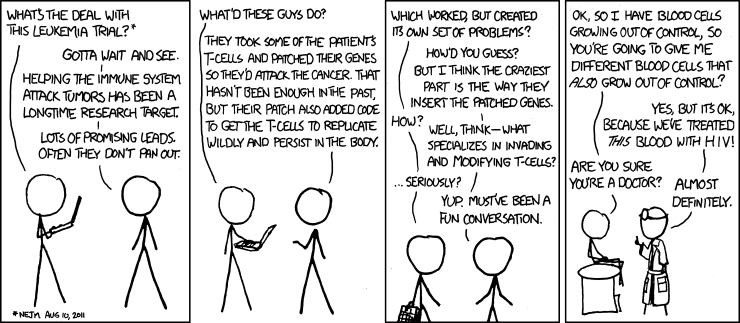
I've only just found xkcd.
So, so cool...
Thoughts on self-employment, working from home, global travel and the challenges of consulting to the health care industry.
Friday, 28 October 2011
Thursday, 27 October 2011
Pesky verbs
Further to yesterday's thoughts on the descriptive noun (art v. science) this week I've been dealing with an even slipperier conundrum, the verb. To whit: -
For some quite understandable reasons the client has decided that the guys on the road wot talk to doctors are hereon out to be referred to as 'health solutions managers'. Because nobody likes being 'sold to' right? But there sure as hell are plenty of health solutions out there that need managing: -
I accept that in much of the world 'salesman' is a tainted word; derisively associated with sharp practices (double glazing in the UK, used cars elsewhere) but excising it from the corporate vocab leaves an glaring absence. Accountants account, researchers research and receptionists receive. Managers either run a team of people or have responsibility for a project or process or else they do... what?
We spent much of the week exploring what it might mean to manage a health solution when the behaviours we want to see exhibited in front of the customer looked consistently salesy.
As I said, the client has understandable reasons for wanting this rebrand but as the behaviours (the verbs) aren't changing then was it any wonder that we spent the week wading through euphemisms?
What is an appropriate euphemism for 'selling'?
For some quite understandable reasons the client has decided that the guys on the road wot talk to doctors are hereon out to be referred to as 'health solutions managers'. Because nobody likes being 'sold to' right? But there sure as hell are plenty of health solutions out there that need managing: -
Beware of Greeks bearing gifts and solutions in search of problems.
I accept that in much of the world 'salesman' is a tainted word; derisively associated with sharp practices (double glazing in the UK, used cars elsewhere) but excising it from the corporate vocab leaves an glaring absence. Accountants account, researchers research and receptionists receive. Managers either run a team of people or have responsibility for a project or process or else they do... what?
We spent much of the week exploring what it might mean to manage a health solution when the behaviours we want to see exhibited in front of the customer looked consistently salesy.
If it walks like a duck and quacks like a duck then why are we struggling so hard to name the damn thing?
As I said, the client has understandable reasons for wanting this rebrand but as the behaviours (the verbs) aren't changing then was it any wonder that we spent the week wading through euphemisms?
Labels:
Big Pharma,
Branding,
Client perception,
Disclipline,
Sales v. Marketing
Wednesday, 26 October 2011
The art of selling
The Schumpeter column in the October 22 Economist (no link available) explores the issue of variability amongst sales teams: -
The article speaks to the problem that it is so difficult to first standardise, then reproduce, the behaviours of the high performers that companies are left frustrated, reduced to describing selling as an 'art' as opposed to a 'science'. I have no problem with this frustration (in fact it benefits me) because I don't see science and art as polar opposites. Furthermore the better metrics that science requires are often fool's gold: -
I like salespeople. It's isn't hard to like people whose job it is to be likeable. The immeasurable that I recognise in the good ones is the same as with high-performing actors, improvisers and stand-up comics, all of whom say words aloud for a living: when they are on the job they are present. This translates into a wonderful ability to slow time such that the thing they say is the only thing that needs saying.
Part of my job is to encourage my clients to see their employees as artists of sorts (we're called Dramatic Change after all). Too much salesforce.com has the effect of turning them into data entry clerks of their own behaviour, which isn't science so much as drudgery.
the performance of salespeople within a single company typically varies by a factor of three. And the difference between the best and worst companies when it comes to selling is far greater than the difference for functions such as supply-chain management, purchasing or finance.I guess I'm so close to this issue (I spend so much time with sales teams, albeit only in health care) that the cross-departmental comparison surprised me. An acceptance of such a broad spread in performance within a team undoubtedly leads to this greater variability between teams or companies. Most of my clients implicitly employ me to improve the performance of the middle 70%; the thinking being that the top 15% are alchemists who we do well to leave undisturbed and the bottom 15% are heading out the door anyway.
The article speaks to the problem that it is so difficult to first standardise, then reproduce, the behaviours of the high performers that companies are left frustrated, reduced to describing selling as an 'art' as opposed to a 'science'. I have no problem with this frustration (in fact it benefits me) because I don't see science and art as polar opposites. Furthermore the better metrics that science requires are often fool's gold: -
Firms are starting to track reps much more closely, usually to their dismay. Salesforce.com sells tools which allow sales managers to track on a daily basis what their minions are up to.A number of clients of mine have been taken in by salesforce.com and similar tracking systems and after nine or so months the same 70-30 rule applies: 15% are unreplicably good, 15% aren't suited to the gig and then there's everyone else. The problem with tracking that middle 70% and the rewarding them on measurable behaviours is that, as the old sales axiom has it, you should expect what you inspect and alas, the measurable behaviours of the alchemists aren't the ones responsible for their success. Furthermore, systems like salesforce.com only work at all when the reps themselves enter the information about what they're doing into the system.
I like salespeople. It's isn't hard to like people whose job it is to be likeable. The immeasurable that I recognise in the good ones is the same as with high-performing actors, improvisers and stand-up comics, all of whom say words aloud for a living: when they are on the job they are present. This translates into a wonderful ability to slow time such that the thing they say is the only thing that needs saying.
Part of my job is to encourage my clients to see their employees as artists of sorts (we're called Dramatic Change after all). Too much salesforce.com has the effect of turning them into data entry clerks of their own behaviour, which isn't science so much as drudgery.
Monday, 17 October 2011
Inclination v. Obligation
Work is an obligation. Even if I really like my job (so much of the time of inclined to do it) I'm obliged to do it regardless of any momentary preference.
When our weekends and holidays 'feel like work' it's because we find ourselves obliged to do things during time we'd mentally put aside to pursue our inclinations. We like our friends because they're similarly inclined to us; time spent with them doesn't feel like an obligation.
I'm visiting Australia again in a few weeks and there's nothing like a trip home to focus the mind: which activities and engagements am I obliged to do, which am I inclined to do and which ones sit happily in the centre zone of a simple Venn Diagram?
This trip will be far more complicated because my wife and I are traveling together. As our separate and collective diaries fill up we're negotiating a much more complex Venn Diagram: there are things that are inclinations for one but obligations for the other, things that are obligations for us both and happily a few things that we're each inclined to do.
Travel alone and the trade-offs are purely internal. Travel with someone else and the negotiations need to be overt and honest otherwise we end up dragging the other person to events that we're only attending out of obligation anyway.
Adult life is a lesson in compromise and never more so than when returning to the sites of your childhood.
When our weekends and holidays 'feel like work' it's because we find ourselves obliged to do things during time we'd mentally put aside to pursue our inclinations. We like our friends because they're similarly inclined to us; time spent with them doesn't feel like an obligation.
I'm visiting Australia again in a few weeks and there's nothing like a trip home to focus the mind: which activities and engagements am I obliged to do, which am I inclined to do and which ones sit happily in the centre zone of a simple Venn Diagram?
This trip will be far more complicated because my wife and I are traveling together. As our separate and collective diaries fill up we're negotiating a much more complex Venn Diagram: there are things that are inclinations for one but obligations for the other, things that are obligations for us both and happily a few things that we're each inclined to do.
Travel alone and the trade-offs are purely internal. Travel with someone else and the negotiations need to be overt and honest otherwise we end up dragging the other person to events that we're only attending out of obligation anyway.
Adult life is a lesson in compromise and never more so than when returning to the sites of your childhood.
Sunday, 16 October 2011
Dreading the week ahead
My 'To Do List' program, Things for Mac, crashed on Saturday morning. At first it was a simple failure to synch between desktop and iPhone but the usual solutions as suggested by the user forums not only failed to fix the fault but made things much, much worse. In trying to copy my database to back it up I managed to delete it altogether.
I've been ambushed by my beloved technology and I approach the week with a woefully imprecise idea of what needs doing.
Wednesday, 12 October 2011
A week I won't get back
I live in London and mostly work in Europe. I have a few North American clients and would like more and I have one in Asia. The rest of the Asia-Pac business is handled by an erstwhile business partner who lives in New Zealand. I'd like to think I'm pretty good at long-distance collaboration.
This week I've been dealing with two quite different men who want to do me the favour of taking my work to new clients. One is setting up a consultancy in the Middle East and reckons that he can generate a demand for our IP in the region and the other needs my skills to round out a product offering that he's making (speculatively) to a Canadian company. Both men are entrepreneurs who have identified potentially lucrative opportunities that would never come across my radar. But each has inserted himself between me and a client and I'm unsure how I feel about that because like most Headcount: 1 types I'm a control freak. If anyone's going to be in front of a client or an audience it will be me.
This control freakery has been going on so long that I've learnt to treat it as a strength rather than the flaw it is. Being unable to delegate means that my business will never, ever be scaleable, ergo it will never be saleable. And as I've said before on these pages, when I get down about this I feel trapped. If I can't relinquish control of the marketing interactions with clients in far-flung places that I'd never meet otherwise then when can I?
Isn't this just 20th Century Thinking? Wasn't one of the key learnings from the life of Saint Steve Jobs that an overweening sense of control is a positive thing? Merlin Mann recently described success, apropos of Apple, as: -
And before we've even gotten to a proper pitch meeting each relationship has gotten bogged down in a separate legal morass. I've spent the last week proofing licensing agreements and drafting cautionary emails. The last seven days' efforts have been about protecting what's mine now instead of creating a better, cooler something for tomorrow.
My business is such that I can't license my way to wealth and I certainly can't sue my way there. A week spent neither developing new ideas or delivering existing ones is a week wasted
This week I've been dealing with two quite different men who want to do me the favour of taking my work to new clients. One is setting up a consultancy in the Middle East and reckons that he can generate a demand for our IP in the region and the other needs my skills to round out a product offering that he's making (speculatively) to a Canadian company. Both men are entrepreneurs who have identified potentially lucrative opportunities that would never come across my radar. But each has inserted himself between me and a client and I'm unsure how I feel about that because like most Headcount: 1 types I'm a control freak. If anyone's going to be in front of a client or an audience it will be me.
This control freakery has been going on so long that I've learnt to treat it as a strength rather than the flaw it is. Being unable to delegate means that my business will never, ever be scaleable, ergo it will never be saleable. And as I've said before on these pages, when I get down about this I feel trapped. If I can't relinquish control of the marketing interactions with clients in far-flung places that I'd never meet otherwise then when can I?
Isn't this just 20th Century Thinking? Wasn't one of the key learnings from the life of Saint Steve Jobs that an overweening sense of control is a positive thing? Merlin Mann recently described success, apropos of Apple, as: -
You get to decide who pays youI suspect that my erstwhile partner doesn't care who pays us for our residual IP. He sees this incremental (and essentially unearned) income purely as a bonus, as an undiluted good, and especially in markets like Egypt and Saudi and the Gulf. I'm not sure I agree. I want my collaborations to enhance not diminish what I do. I want to finish a project with a stronger brand, a more interesting product and a new set of experiences.
And before we've even gotten to a proper pitch meeting each relationship has gotten bogged down in a separate legal morass. I've spent the last week proofing licensing agreements and drafting cautionary emails. The last seven days' efforts have been about protecting what's mine now instead of creating a better, cooler something for tomorrow.
My business is such that I can't license my way to wealth and I certainly can't sue my way there. A week spent neither developing new ideas or delivering existing ones is a week wasted
Wednesday, 5 October 2011
Chien noir. Perro negro. Cane nero...
At a dinner at a European pharma meeting last night the conversation couldn't escape the financial crisis. Budgets slashed. Health ministries paralysed by the turmoil. Every hospital, therapy area, patient group and drug company desperately seeking an ever-larger share of a shrinking pie just to keep up.
"My dog's blacker than yours" in twelve European languages
Monday, 3 October 2011
Part of me
Part of me wants to stress over flight connections and the like. For the amount of emotional energy I expend in this way it's the only viable explanation.
Air travel: a procession of small humiliations.
Heathrow Express: your air travel experience starts here
Air travel: a procession of small humiliations.
Heathrow Express: your air travel experience starts here
Sunday, 2 October 2011
Getting good at the new thing
Kevin Kelly recently posted a great essay entitled What You Don't Have To Do. He sets out hierarchy of ascending levels of 'working smart': -
This is a profoundly elegant understanding of what success looks like. It's how a good careers have always unfolded: apprentice then journeyman then master.
When I think about those around me in unhappy careers (which is not the same as being in an unhappy workplace) oftentimes there's a disconnect between where someone believes he sits on this ladder and what the employer believes. You won't be paid a premium to do something only you can do until you prove you can do the things anyone else can do*. A clear sign that you've gotten this wrong is when your veiled threats about quitting are met with bemusement. Or relief. You will only extract a greater cost from your employer if you're operating at Level 6. The leading lady can shut down production by staying in her trailer. The extra playing Nervous Inmate #3 cannot.
Having a relatively new career in stand-up comedy to compare with longer ones in pharma consultancy and improv provides me with a natural experiment in this. As a consultant I'd like to think I operate at Level 5 and occasionally 6; I deliver good work and many clients reckon that only I can do that work. As a stand-up comic I strive to stay at Level 2 where success on any given night is measured in doing more than simply surviving the show. But perhaps the bitterest pill to swallow is that even though I'm a 20-year improv veteran (i.e. I started this before consultancy) I'm no more than a solid Level 4. Whilst I can be relied on to deliver a solid performance, I've never been indispensable to the long-term success of a show.
My proof that this is more than an unusually piquant blend of my standard brew of self-pity and smugness is that whereas I often get unsolicited approaches to do consulting work that is interesting, specialised (and therefore lucrative) in the comedy world I'm just another name on a list. Without a constant effort keeping my name in front of promoters I don't get gigs.
Nevertheless though hard work and luck I have one aspect of my working life, consulting, where I'm seen as a bit special. Regardless of what the motivational bloggers say, not everyone has or will ever have that. The brutal fact is that even sweat and ego-free dedication do not guarantee progression in an adult life. This is why a late-life career change scares us so: what if we run out of time to actually get good at the new thing?
* Freelancers: replace the phrase 'the employer' with 'the market'.
- Doing what is required
- Doing more than is required
- Trying as many roles as you can in order to discover what you are smart at
- Making sure you are spending your time on jobs that are effective or that need to be done at all
- Do only jobs (that really need to be done) that you are good at doing
- Doing that work that no one else could do
This is a profoundly elegant understanding of what success looks like. It's how a good careers have always unfolded: apprentice then journeyman then master.
When I think about those around me in unhappy careers (which is not the same as being in an unhappy workplace) oftentimes there's a disconnect between where someone believes he sits on this ladder and what the employer believes. You won't be paid a premium to do something only you can do until you prove you can do the things anyone else can do*. A clear sign that you've gotten this wrong is when your veiled threats about quitting are met with bemusement. Or relief. You will only extract a greater cost from your employer if you're operating at Level 6. The leading lady can shut down production by staying in her trailer. The extra playing Nervous Inmate #3 cannot.
Having a relatively new career in stand-up comedy to compare with longer ones in pharma consultancy and improv provides me with a natural experiment in this. As a consultant I'd like to think I operate at Level 5 and occasionally 6; I deliver good work and many clients reckon that only I can do that work. As a stand-up comic I strive to stay at Level 2 where success on any given night is measured in doing more than simply surviving the show. But perhaps the bitterest pill to swallow is that even though I'm a 20-year improv veteran (i.e. I started this before consultancy) I'm no more than a solid Level 4. Whilst I can be relied on to deliver a solid performance, I've never been indispensable to the long-term success of a show.
My proof that this is more than an unusually piquant blend of my standard brew of self-pity and smugness is that whereas I often get unsolicited approaches to do consulting work that is interesting, specialised (and therefore lucrative) in the comedy world I'm just another name on a list. Without a constant effort keeping my name in front of promoters I don't get gigs.
Nevertheless though hard work and luck I have one aspect of my working life, consulting, where I'm seen as a bit special. Regardless of what the motivational bloggers say, not everyone has or will ever have that. The brutal fact is that even sweat and ego-free dedication do not guarantee progression in an adult life. This is why a late-life career change scares us so: what if we run out of time to actually get good at the new thing?
* Freelancers: replace the phrase 'the employer' with 'the market'.
Subscribe to:
Comments (Atom)

